
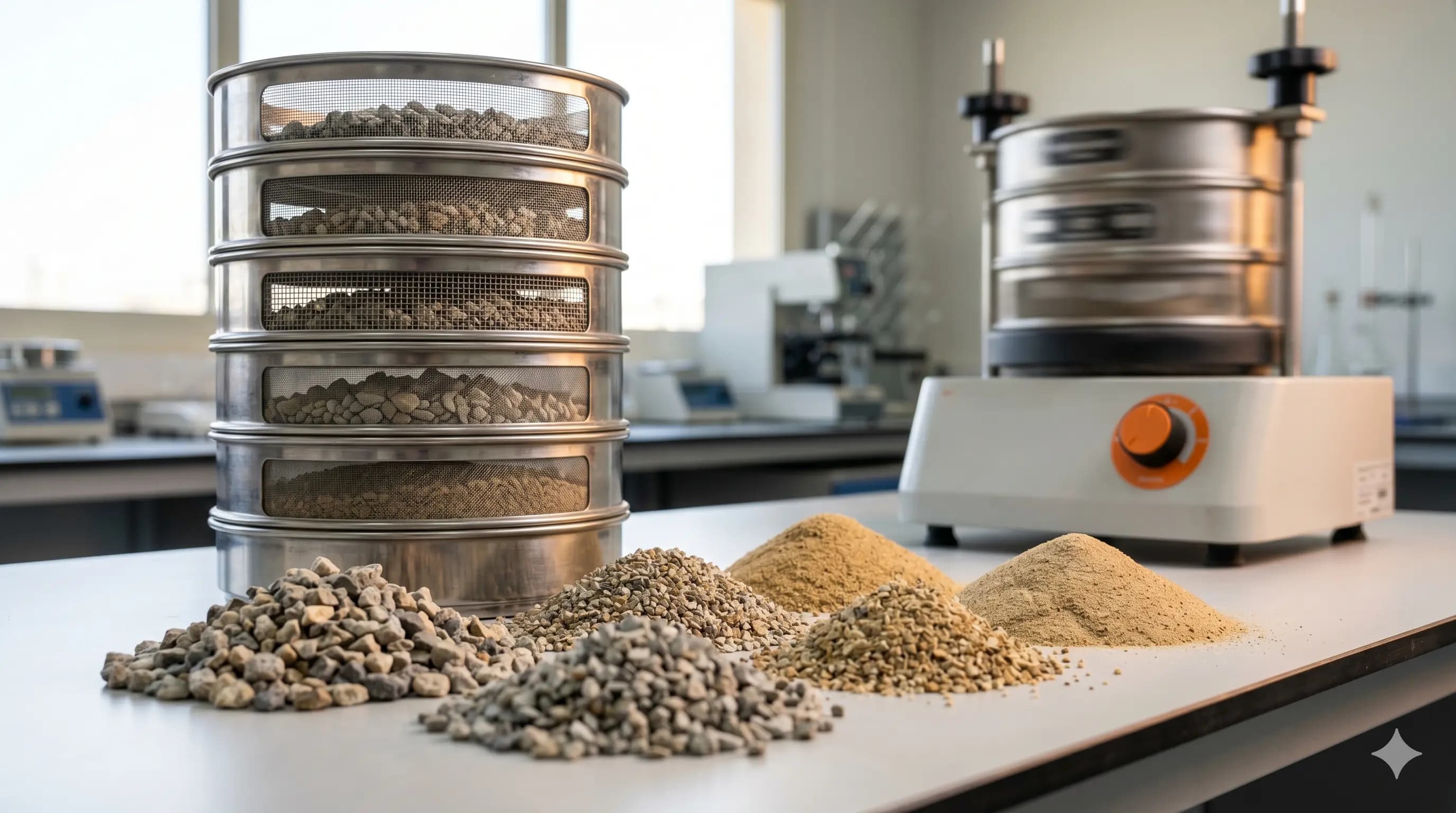
Aggregate testing does not produce one universal “good” or “bad” verdict. Results for gradation, relative density, absorption and abrasion must be evaluated for the intended use against the project specification—and every decision starts with a representative, traceable sample.
This guide explains how to read sand and gravel results. For a test scope and quotation for a specific sample, see our aggregate testing service.
Fine vs Coarse Aggregate
Fine aggregate is the smaller portion of the particle-size distribution, commonly sand; coarse aggregate includes larger gravel or crushed stone. The dividing sieve and nominal size come from the material and use specification, not the name alone. Aggregate for concrete, asphalt and road layers can have different acceptance envelopes.
Sampling Comes First
An accurate laboratory result may still fail to represent a delivery when material is taken only from an easy point or a segregated stockpile surface. Record the source, truck or stockpile ID, sampling date, intended use and sampling method. Supplier comparisons require the same sampling and preparation plan.
Aggregate Sieve Analysis and Gradation
Under ASTM C136/C136M, a suitable dry test mass is weighed and passed through a sieve stack. The mass retained, cumulative mass retained and percentage passing are calculated. Material finer than the 75-μm sieve by washing is determined under ASTM C117 when required. The key output is a grading curve compared with the envelope in the project specification.
Worked Sieve-Analysis Example
This illustrative 1,000 g sample demonstrates the calculation only; the values are not acceptance limits:
| Sieve | Retained (g) | Cumulative (g) | Passing (%) |
|---|---|---|---|
| 9.5 mm | 0 | 0 | 100 |
| 4.75 mm | 80 | 80 | 92 |
| 2.36 mm | 220 | 300 | 70 |
| 1.18 mm | 280 | 580 | 42 |
| 600 μm | 240 | 820 | 18 |
| Pan | 180 | 1,000 | 0 |
For example, passing the 2.36 mm sieve = 100 − (300 ÷ 1,000 × 100) = 70%. Project limits are then added to the table or curve and compliance is checked sieve by sieve.
Relative Density, Absorption and Bulk Density
These terms are not interchangeable; confusing them can distort mix calculations or quantity conversions:
- Relative density (specific gravity): describes particle density relative to water; ASTM C127 covers coarse aggregate and ASTM C128 covers fine aggregate.
- Absorption: the water entering permeable pores, used when correcting batch water and moisture condition.
- Bulk density (unit weight): aggregate mass in a known container volume, including interparticle voids, determined under ASTM C29/C29M.
Other Tests Selected by End Use
- Los Angeles abrasion, ASTM C131/C131M: measures degradation by abrasion and impact for small-size coarse aggregate. There is no universal acceptance percentage; compare the result with the contract specification.
- Sodium or magnesium sulfate soundness, ASTM C88: measures resistance to the method's specified disintegration cycles.
- Clay lumps and friable particles, ASTM C142/C142M: determines their percentage in the sample.
- Organic impurities, ASTM C40/C40M: a colorimetric check for organic impurities in fine aggregate for concrete—not a general test for every deleterious material.
How to Read an Aggregate Test Report
Check sample identity, source and date; test method and edition; sample condition; results and units; any supplied project limits; and the conclusion. A report on one sample does not automatically qualify an entire supplier or every later delivery. That depends on the sampling plan and surveillance frequency.
Supplier-Comparison Checklist
- Compare representative samples obtained by the same procedure.
- Hold aggregate type, nominal size and intended use constant.
- Request the same methods and project limits for every supplier.
- Compare the complete grading curve, not one sieve result.
- Monitor source or stockpile changes at the project-defined frequency.
If you have a sample or project specification, send the material type, intended use and requested methods for an aggregate testing scope and quotation.