
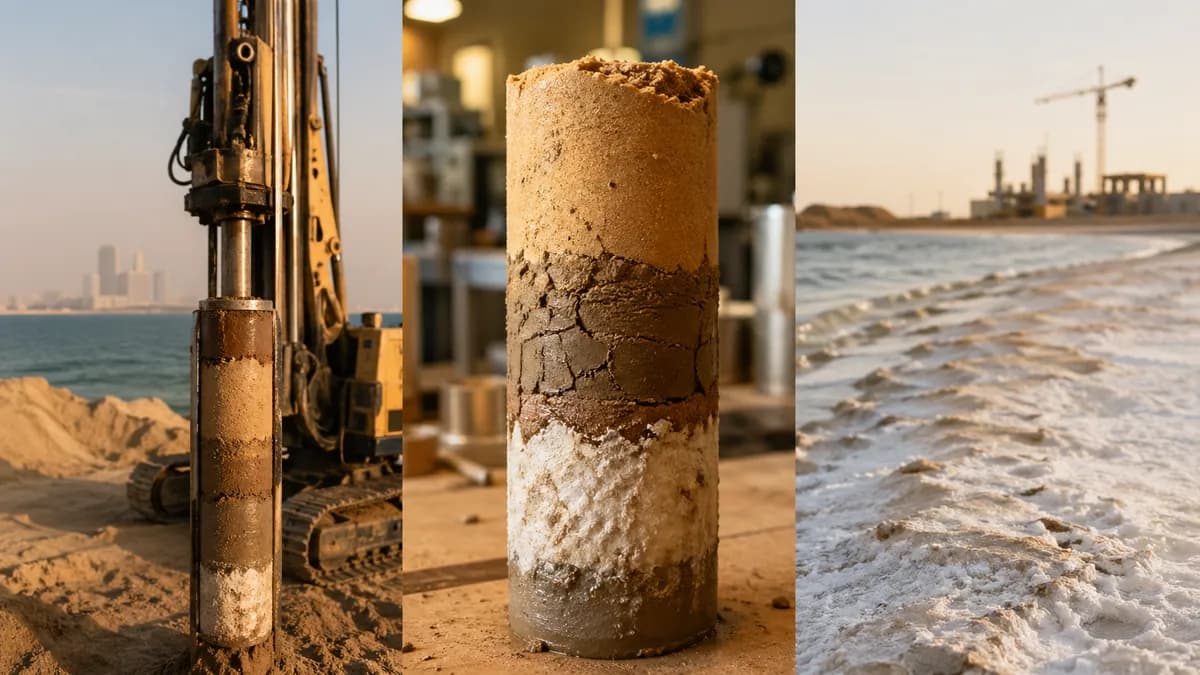
A Coastal City with Temperamental Ground
In Jeddah, a few kilometers can separate excellent sandy founding ground from sabkha that devours concrete with its salts. That variability is what makes soil testing in Jeddah a decisive engineering call rather than paperwork: the results dictate the foundation system, the concrete grade, and the waterproofing approach.
The Three Faces of Jeddah's Soil
Coastal sand
The most widespread type: excellent drainage and easy excavation — but beware where it is loose, as bearing capacity drops and compaction or treatment becomes necessary.
Clay layers
They hold water and change with it: swelling when wet, shrinking when dry — behavior that undermines shallow foundations unless accounted for.
Saline sabkha
The silent enemy of shoreline zones: elevated sulfates and chlorides gnaw at concrete and rust reinforcement, while bearing capacity decays over time. It forces sulfate-resistant concrete and strict waterproofing.
Jeddah's Three Big Geotechnical Hazards
- Differential settlement: soil properties varying within a single plot make the building settle unevenly — cracking and tilting follow.
- Shallow groundwater: the signature of coastal districts — it complicates excavation, weakens soil, raises costs, and calls for dewatering and waterproofing systems.
- Chemical corrosion: salts in soil and water creep into concrete and rebar, cutting the structure's service life.
From Soil to Foundation: How the Decision Is Made
Strong, stable soil → shallow foundations: isolated footings, strips, or a raft.
Weak soil or high groundwater → deep foundations: piles or caissons carrying loads down to firmer strata.
There is no third path: the decision rests on borehole numbers, not the neighbor's experience.
The Recommended Test Package for Jeddah
- ✔️ Borings revealing the layer sequence and groundwater level
- ✔️ SPT per ASTM D1586 for strength and density
- ✔️ Chemical analyses for sulfates and chlorides — indispensable near the coast
A Geotechnical Map of the Districts
| Zone | Dominant soil | What to watch for |
|---|---|---|
| Corniche & the south | Coastal sand & sabkha | Salts and shallow groundwater |
| Central districts | Medium-dense sand | Bearing capacity varying plot to plot |
| The east & expansions | Sandy gravel & rock | Hard, costly excavation |
| The north & new projects | Loose sand & fills | Potential settlement within fill layers |
The Bill for Building Untested
- ❗ Settlement surfacing after occupancy
- ❗ Creeping cracks across walls
- ❗ Water seepage into basements and footings
- ❗ Endless, draining maintenance
- ❗ In extreme cases: partial or total failure
Our Jeddah Field Team at Your Service
From Al-Furusiya, TECHNO Soil Lab's field team covers every district of Jeddah: borings for all project types, a full SBC 303 testing program, chemical analyses for coastal soils, and certified reports that clear the Baladi platform and government authorities.
Bottom Line
Jeddah's soil cannot be treated by one rule: every district has its own geotechnical file. Test first, then design your foundations on what the testing revealed — that is how you build in Jeddah with lasting confidence.