
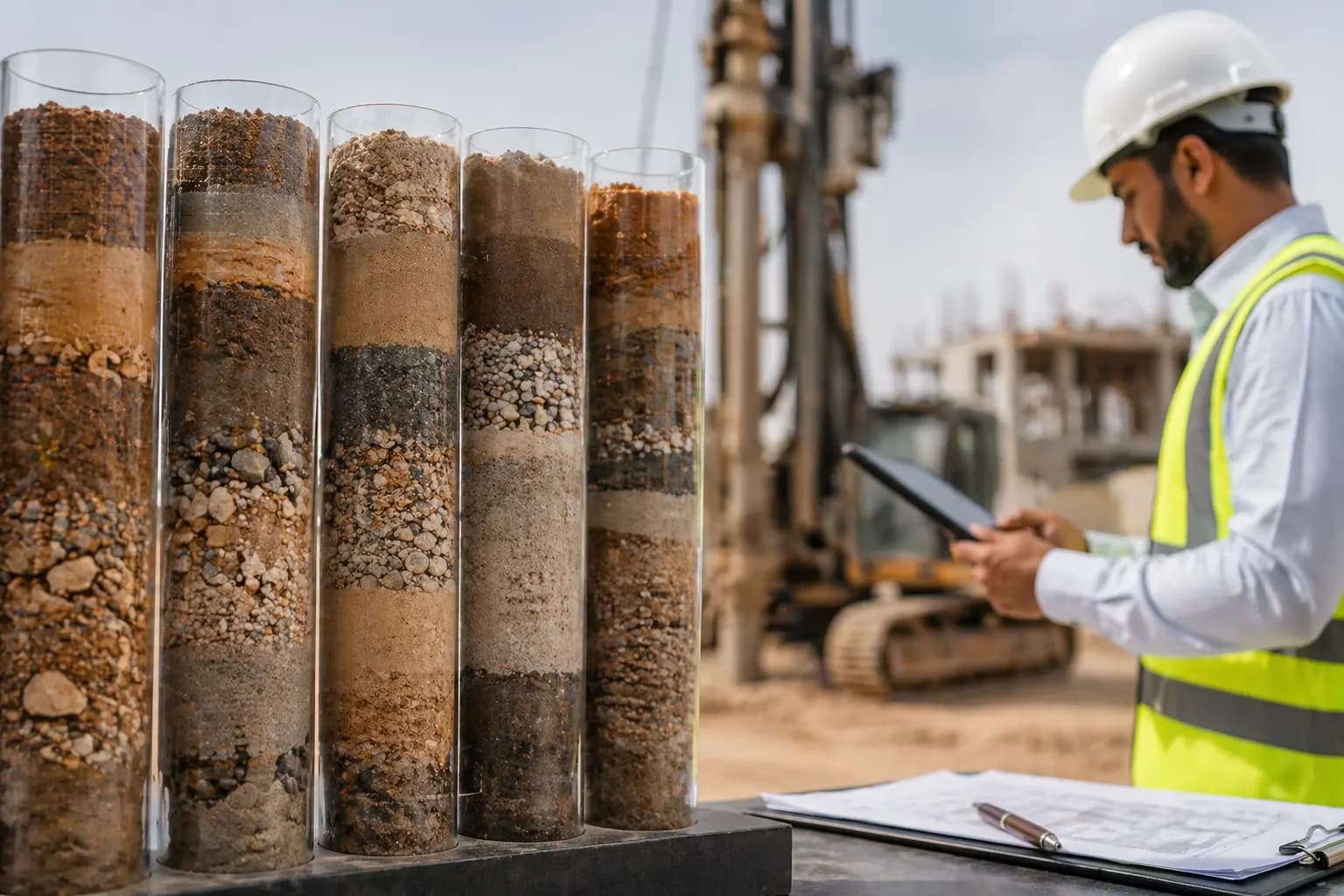
Before the first pour and the first footing, a silent conversation must take place between you and your site — and soil testing is the language of that conversation. This article walks through what each test measures, why the designer asks for it, and how its numbers become foundation decisions.
What Soil Testing Actually Covers
It is a sequence of field and laboratory checks answering five essential questions about your site:
- How much load can this ground carry? (bearing capacity)
- How dense and cohesive is it?
- How much moisture does it hold, and how does it behave with it?
- What are its layers made of, and how are they classified?
- Where does the groundwater table sit?
With those answers, the engineer selects the foundation type, depth, and design — on numbers, not guesswork.
The Five Essential Tests
1) Standard Penetration Test (SPT) — the ground's strength meter
The most common in-situ test on Saudi projects: a standard hammer falls from a fixed height, and the blow count needed to drive the sampler a set distance translates directly into layer strength, bearing capacity estimates, and the right founding depth.
2) Nuclear field density — the watchdog of earthworks
After every fill layer, the nuclear gauge reads the compacted density within minutes and compares it to the required compaction ratio. Without it there is no proof the fill met specification — and no guaranteed stability for slabs and roads.
3) Sieve analysis — the soil's identity card
Particle-size distribution classifies the soil (sandy, gravelly, fine) and rules on its fitness as fill material — the test that overlaps directly with aggregate testing requirements.
4) Atterberg limits — the mood of clay
Clayey soil is temperamental with moisture: it swells, shrinks, and cracks. The liquid limit, plastic limit, and plasticity index expose that behavior in advance and steer design decisions on clay-rich sites.
5) Direct shear — computing slide resistance
Measures the soil's shear strength — the number that designers of foundations, retaining walls, and slopes need to prevent sliding failures.
When Testing Is a Duty, Not an Option
- Before purchasing land intended for construction
- Before foundation design begins
- When considering adding floors to an existing building
- On road and infrastructure projects
- The moment cracks or settlement appear in an existing structure
The Invoice for Skipping the Test
Whoever saves the cost of testing eventually pays one or more of these bills instead:
- Differential settlement that distorts and endangers the building
- Spreading cracks across walls and floors
- Foundation failure requiring costly underpinning
- Project stoppage and delayed handover
- In extreme cases: total loss of the structure
Reading the Soil Report Like an Engineer
A good report is not stacked numbers but a decision map. Look for:
- The layer sequence described for each borehole
- Complete field and laboratory results
- The calculated allowable bearing capacity
- The groundwater level and how to deal with it
- The recommended foundation type and founding depth
Those pages remain the reference for both designer and contractor throughout execution.
Questions to Ask Before Hiring a Lab
- Is the equipment modern, with valid calibration records?
- Is the team made up of specialized engineers or technicians only?
- Are the reports certified and accepted by government authorities?
- What is the turnaround time?
- Do they have a track record on similar projects?
Why Clients Trust TECHNO Soil Lab
- Reports certified to ASTM and the Saudi Building Code (SBC)
- Calibrated instruments and fast-response field crews
- Result accuracy that designers and consultants rely on
- Experience spanning residential villas to industrial facilities
Bottom Line
Every riyal spent on soil testing buys engineering certainty worth many times more later. Start the conversation with your ground before you build on it — order your soil test now.