
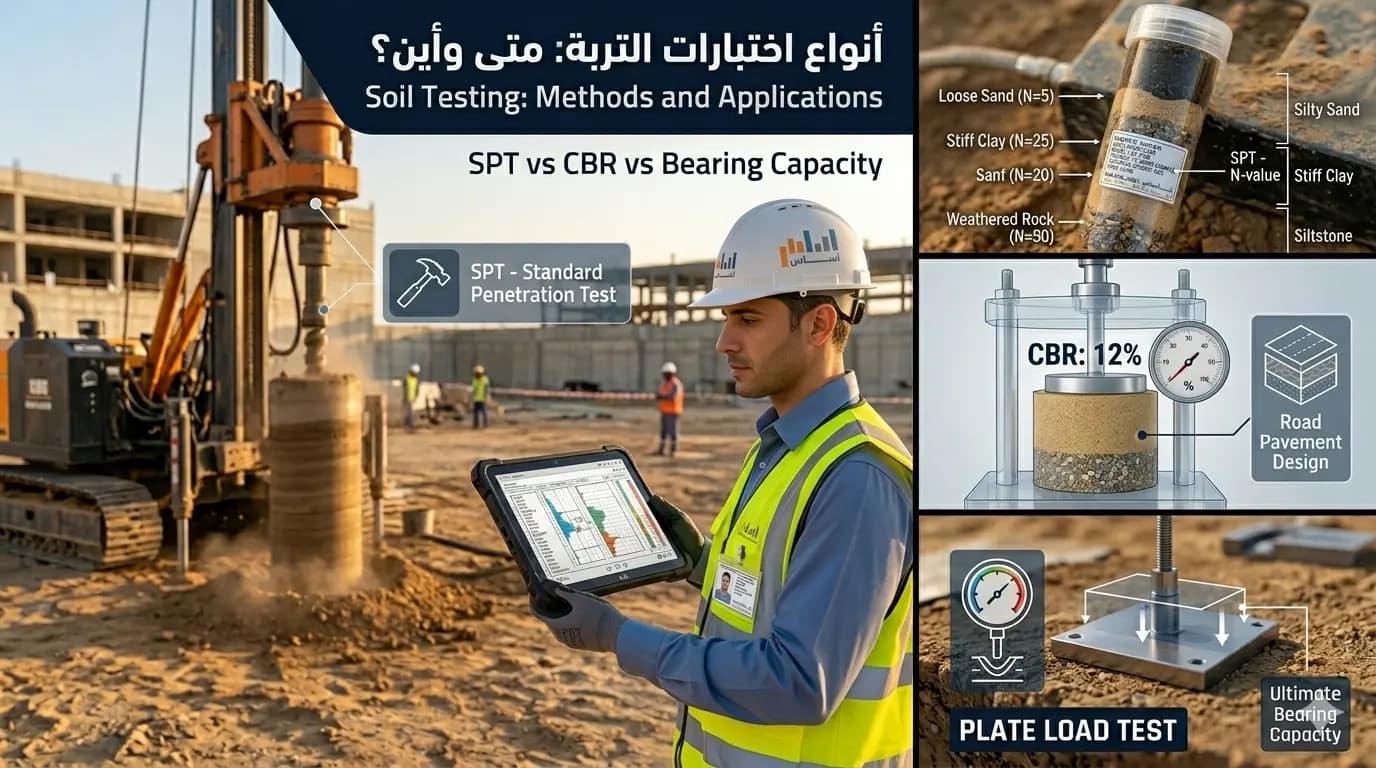
One Test Does Not Fit All
The request "test our soil" opens a counter-question: which test, exactly? Soil changes with depth and differs between cities, and structures themselves ask different questions — a building asks about bearing capacity, a road asks about its layers' fitness, and fill asks about its compaction ratio. This map guides you to the right soil test for each case.
First: SPT — the Backbone of Building Reports
During boring, a standard hammer drives a sampler and the blows needed for 30 cm of penetration are counted. The resulting N-value is the shared language geotechnical engineers use to describe layer strength. It is mandatory in SBC 303 reports for all residential and commercial buildings, and is also used to estimate liquefaction risk in saturated sands.
Reading the N-value
| N | Soil condition | Likely foundation direction |
|---|---|---|
| Below 4 | Very soft clay | Deep piles |
| 4 – 10 | Medium clay | Raft or piles |
| 10 – 30 | Medium-dense sand | Isolated footings or raft |
| Above 30 | Dense sand or rock | Isolated footings |
Second: CBR — the Road Engineer's First Question
The California Bearing Ratio compares the soil's penetration resistance with that of standard crushed stone and reports a percentage: the higher it is, the fitter the soil as a subgrade or base layer. It is called for in:
- Designing new road and street pavement layers
- Evaluating subgrade and subbase before laying
- Airport aprons and heavy-load industrial yards
Third: Plate Load — the Direct Field Measurement
Rather than inferring from N-values, this test sets a steel plate at foundation level and actually loads it in increments while measuring settlement in real time. It is the most accurate field testimony on bearing capacity, which is why it is summoned for:
- Towers and high-rise structures
- Settling cases where SPT results conflict
- Final verification before major foundation pours
Fourth: Nuclear Density — an Instant Verdict on Compaction
A portable gauge reads soil or asphalt density and moisture within minutes, no lab wait — the accepted tool for approving or rejecting every fill or pavement layer before the next one goes down.
The Combined Table
| Test | What it measures | Best domain |
|---|---|---|
| SPT | Layer strength and classification | All building reports |
| CBR | Pavement layer fitness | Roads and airports |
| Plate Load | Actual bearing capacity and settlement | Towers and heavy structures |
| Nuclear density | Compaction density and moisture | Fill and road layers |
All of these tests are available from TECHNO Soil Lab Company with certified field crews and calibrated instruments in Makkah, Jeddah, Madinah, Riyadh, and Qassim.
Bottom Line
Ask first: what am I building? Then pick the test: SPT for buildings, CBR for roads, Plate Load for towers and critical cases, and nuclear for compaction acceptance. The right test at the right stage means foundations designed on facts, not assumptions.