
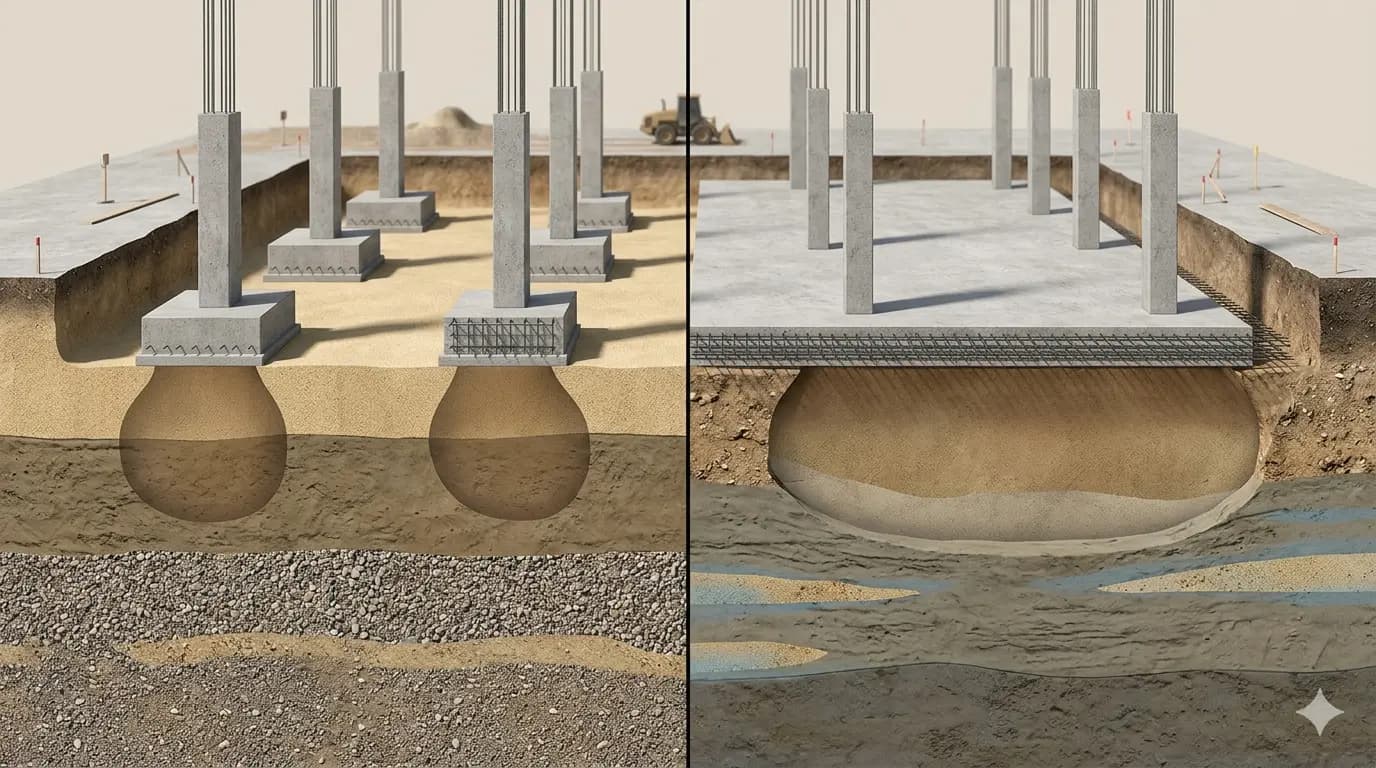
When your project reaches the "raft or isolated footings?" question, you will hear plenty of opinions: the contractor prefers the faster option, the budget prefers the cheaper one. But the only opinion that counts, engineering-wise, is written in the soil investigation report — it alone knows what awaits your foundations below the surface.
Isolated Footings: the Solution for Confident Soil
An independent concrete base under each column carries its load straight into the ground. The simplest system to build and the most economical — under one strict condition: strong, uniform soil that tolerates concentrated pressures at discrete points. A hidden weak layer under a single footing means uneven settlement that later shows up as cracks.
The Raft: a Carpet That Spreads the Loads
A reinforced slab covering the building's entire footprint, distributing its loads over the largest possible soil area. You reach for it when the soil is weak, variable, or the groundwater sits high — pressures per square meter drop, and if the building settles, it settles as one body. More expensive, yes — but that is the price of stability where alternatives fail.
Which Data Does the Report Judge By?
- Bearing capacity computed from the borings
- Layer uniformity — or lack of it — across the site
- The groundwater level
- SPT values through the depths
- Chemistry: salts and sulfates influencing the concrete type
And the ruling logic is direct:
- Strong, uniform soil with comfortable capacity → isolated footings: economy and efficiency
- Weak or variable soil, or high water → a raft: safety and stability
Mistakes That Keep Repeating
- Picking isolated footings "to save" despite the report's warning
- Skipping the report and leaning on nearby-site experience
- Neglecting the groundwater level and its effects
- Underrating the expected settlement and its differentials
The usual endings: spreading cracks, foundation settlement, and rework that swallows all the "savings" and multiples of it.
Where Does the Lab Stand in the Decision?
A serious laboratory does not hand you raw numbers and walk away. At TECHNO Soil Lab we analyze the borings, SPT, and laboratory results and shape them into a clear engineering recommendation on the foundation system best suited to your site — to international standards, in a certified report your designer can build on directly.
Bottom Line
Do not let the budget or the schedule pick your building's foundation. Strong soil rewards you with economical isolated footings; weak soil warns you toward a raft — and in both cases, the accurate soil report speaks first and last.