
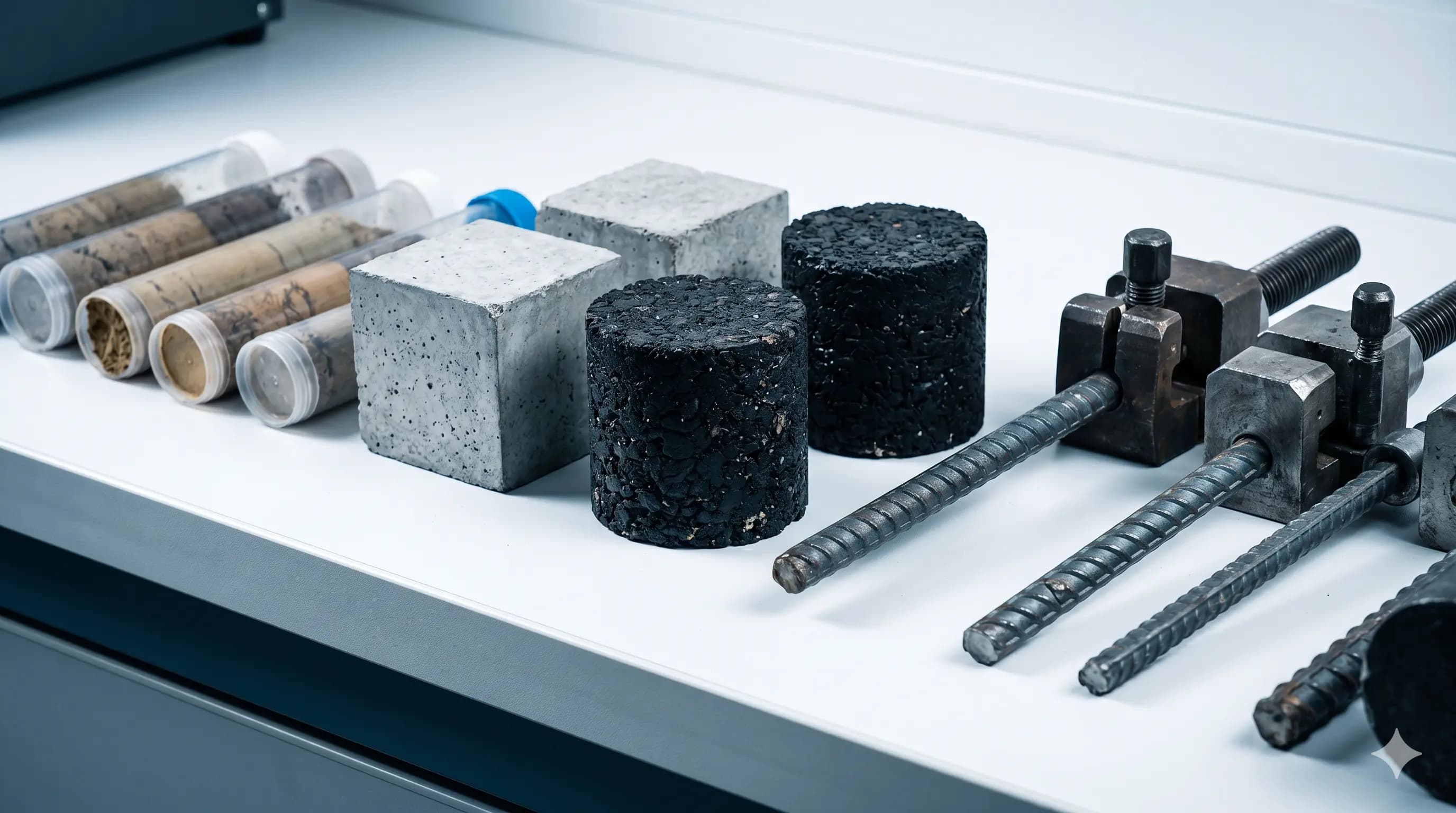
📋 The Map in Brief
- Six testing tracks accompany a project from the first boring to handover
- Soil is tested before any design line is drawn — never after
- Each material (concrete, steel, asphalt, aggregate) has its own protocol and standards
- No result carries regulatory weight unless issued by an accredited laboratory
A construction project is a chain of decisions, and every decision needs evidence. In the construction world, that evidence is called a "certified test report." This map walks the six tracks Saudi projects require, with each test's standard and purpose.
Track One: Soil — Where Everything Begins
No design before knowing the ground. Soil tests draw the geotechnical file that foundation selection is built on:
| Test | The question it answers | Standard |
|---|---|---|
| SPT | Layer strength and capacity at depth | ASTM D1586 |
| CBR | Soil fitness for road layers | ASTM D1883 |
| Particle-size analysis | Classifying sand, silt, and clay | ASTM D422 |
| Atterberg limits | Soil behavior with moisture | ASTM D4318 |
| Proctor compaction | Maximum dry density for fill | ASTM D698 |
We run this track from our head office in Makkah and field teams in Jeddah, Riyadh, Madinah, and Qassim.
Track Two: Concrete — Before and After the Pour
Concrete testing fights on two fronts: approving the mix before the pour, and proving strength after it:
- Compressive strength: 150×150 mm cubes crushed at 7 and 28 days per ASTM C39 or BS EN 12390-3 — the master test and the most requested.
- Slump: the acceptance gate for consistency and workability as the mixer arrives.
- Air content: tracking entrapped air within the mix.
- Permeability: indispensable for tanks, basins, and moisture-exposed structures.
- Schmidt hammer: a non-destructive estimate of in-place concrete strength.
Track Three: Asphalt — Road Life Is Measured in the Lab
Asphalt tests secure roads that withstand traffic and heat:
- Marshall (ASTM D6927): mix stability and flow — the design reference for any mix.
- Penetration (ASTM D5): the hardness of raw bitumen.
- Softening point: the thermal range where asphalt softens — decisive in the Kingdom's summers.
- Density and air voids: compaction quality after laying.
- Extraction: actual bitumen content versus design.
Track Four: Rebar — the Structure's Muscles
Rebar testing covers:
- Tensile (ASTM A370): yield strength, ultimate resistance, and elongation.
- Bend: the bar's flexibility and surface integrity when formed.
- Rebend: endurance under repeated stresses.
- Chemistry (SASO ASTM A615): carbon, sulfur, and phosphorus within limits.
Track Five: Aggregate — Three Quarters of the Mix
Aggregate testing protects concrete and asphalt alike:
- Sieve analysis: a size distribution that achieves the optimal mix.
- Los Angeles abrasion: resistance to crushing and wear.
- Absorption and density: controlling the mix's actual water.
- Deleterious materials: clay and dust within SASO limits.
Track Six: Chemistry — the Invisible Enemy
Chemical analysis spots what attacks the structure silently:
- Mixing water: free of sulfates, chlorides, and organics.
- Soil sulfates: a core issue in Saudi Arabia's gypsum-bearing soils.
- Groundwater: its aggressiveness toward foundations and concrete.
- Chloride in concrete: the rebar's shield against corrosion.
When Does Testing Become Mandatory in the Kingdom?
- At building-permit issuance — the soil report is required above one story
- On government infrastructure: roads, bridges, and transport
- On commercial and industrial projects of any size
- At handover between contractor and developer or government entity
- In any technical dispute calling for a neutral party's report
💡 The Budget Rule
A soil report costs under 0.1% of a project budget — a wrong foundation can cost the whole building. Early testing is not an expense; it is insurance.