

This is a contractor's receiving checklist, not a generic guide to block types and sizes. It covers concrete masonry units, interlock pavers, and curbstones from the delivery gate through the laboratory report, with a direct route to block, interlock paver, and curbstone testing.
What Should You Check Before Unloading a Block Delivery?
Check identity and condition before counting alone. Match the product type, nominal size, and quantity to the purchase order, then record the supplier, batch, and available production date before the delivery can be mixed with existing stock.
Before unloading, inspect several pallet faces for cracks, broken corners, scaling, crumbling, distortion, and conspicuous color or texture changes. Compare counts with the delivery note and photograph damage. Missing labels, unclear production dates, or unidentified mixed batches are traceability warnings.
How Do You Check Block and Interlock Paver Dimensions on Site?
Use a tape measure as a screening check against the order, not as a final laboratory conformity decision. Select units from the top, middle, and lower parts of more than one pallet and record length, width, height, or thickness as relevant.
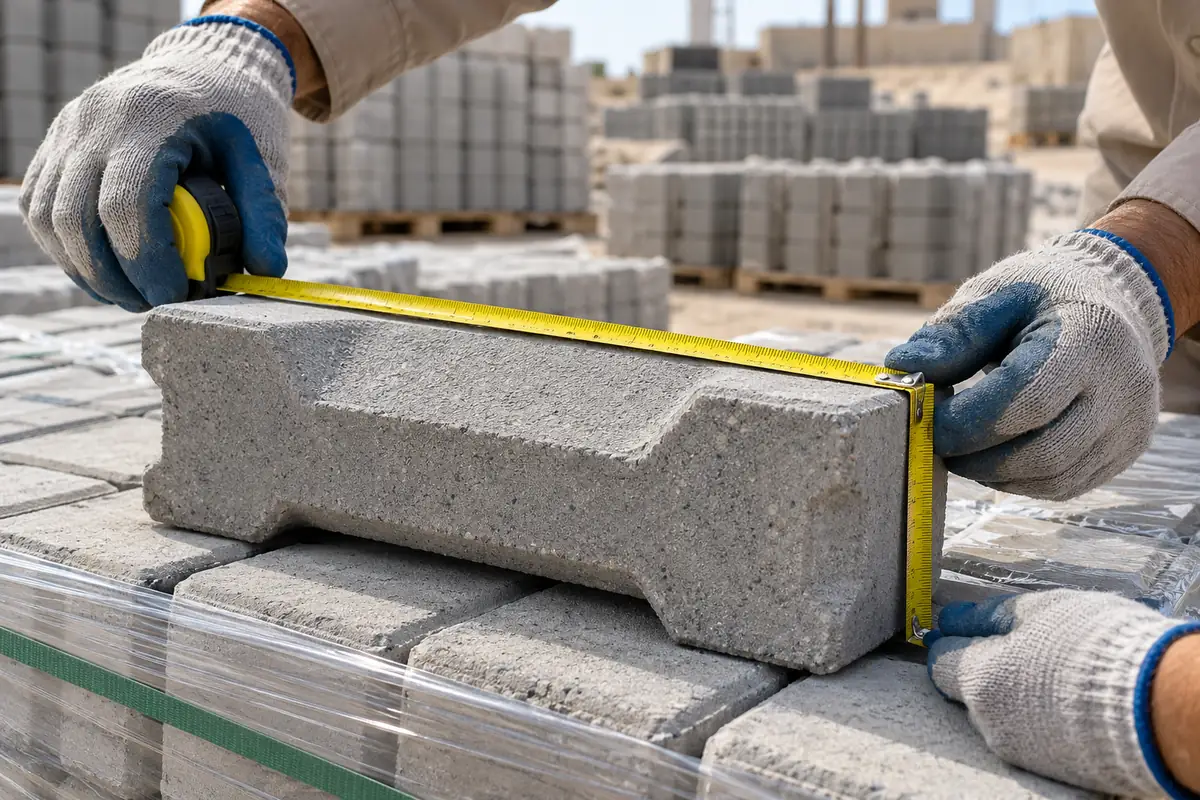
Hollow units may require wall or web measurements; curbstones need the correct section and edge profile. Paver thickness and geometry affect the pattern and level. Compare readings with the order, drawings, governing specification, and supplied tolerances—not a common market size. Repeated differences justify laboratory checks.
Block and Interlock Delivery Checklist
This checklist puts the evidence needed for the receiving decision in one place. Complete each row and attach photographs and documents; a “review” item is not an automatic acceptance or rejection without the contract and consultant's direction.
| Item | Review | Action if Noted |
|---|---|---|
| Identity | Product, supplier, batch, production date, labels | Separate and complete records |
| Visual condition | Cracks, corners, scaling, color, texture | Photograph and quantify |
| Dimensions | Length, width, height or thickness versus order | Expand checks and request lab measurement |
| Quantity | Pallets, units, and delivery document | Record shortages before signing |
| Age and curing | Production date and project requirement | Request evidence; assume no universal age |
| Specimens | Quantity, selection, seal under the plan | Coordinate consultant and laboratory |
When Should You Sample, and Which Tests Are Available?
Take representative specimens when the project requires testing, repeated concerns appear, or the authorized party needs evidence before acceptance. The project specification or consultant sets the number and distribution; there is no universal count for every unit and lot.
Label specimens with the project, supplier, product, batch, delivery date, and sampling location. Do not choose only top units or combine lots. Protect them during transport and provide the specification and required criteria.
Tests listed by TECHNO Soil Lab include compressive strength, water absorption, and density under ASTM C140 where that reference applies, plus dimensions. Fire resistance for blocks, flexural strength where required by the product standard, and splitting tensile strength where requested are also offered. The complete list is not automatically appropriate for every product; first identify whether the specimen is a block, paver, or curbstone and state its use and specification.

Related guidance covers aggregate testing and engineering tests for construction materials.
Why Do Curing Age and Batch Records Matter?
The production date gives the result context and prevents units of different ages or batches from being treated as one lot. Request the recorded date and curing requirement from project or product documents; do not assume one fixed age for every block and paver.
Properties develop during curing, while storage and transport affect condition. The consultant and laboratory need the production date and storage history to follow the specification. A missing or conflicting date requires investigation, not an estimate.
What Does the Laboratory Report Contain?
A useful report connects every result to an identified specimen, test method, and reference. It describes the submitted and tested specimens; it does not automatically approve the entire delivery or all factory production.
It normally states the project, product and batch identity, specimen quantity and condition, sampling method where applicable, actual dimensions, individual results and averages, requested test results, reference, calculation basis, and any scoped comparison with supplied limits. Match specimen numbers to the sampling record before using it for payment or supply decisions.
When Should Installation or Supplier Payment Be Held?
Temporarily isolate and stop using a delivery when a red flag may affect conformity or traceability, then refer the evidence to the authorized party. Final rejection or a payment hold belongs to the consultant and contract, not to a site impression or laboratory alone.
Red flags include the wrong product or dimensions, recurring damage, unidentified mixed batches, missing required records, results outside supplied requirements, or untraceable specimens. Keep the lot marked and unused while the decision is pending. For price comparisons, normalize paver type, size, thickness, finish, quantity, transport, and testing scope; this checklist gives no prices.
Arrange Testing Before the Delivery Is Used
Coordinate before the shipment arrives so the sampling plan, standard, and tests are agreed without delaying the site. Send TECHNO Soil Lab the product type, size, use, batch data, specification, and the specimen quantity defined by the project.