
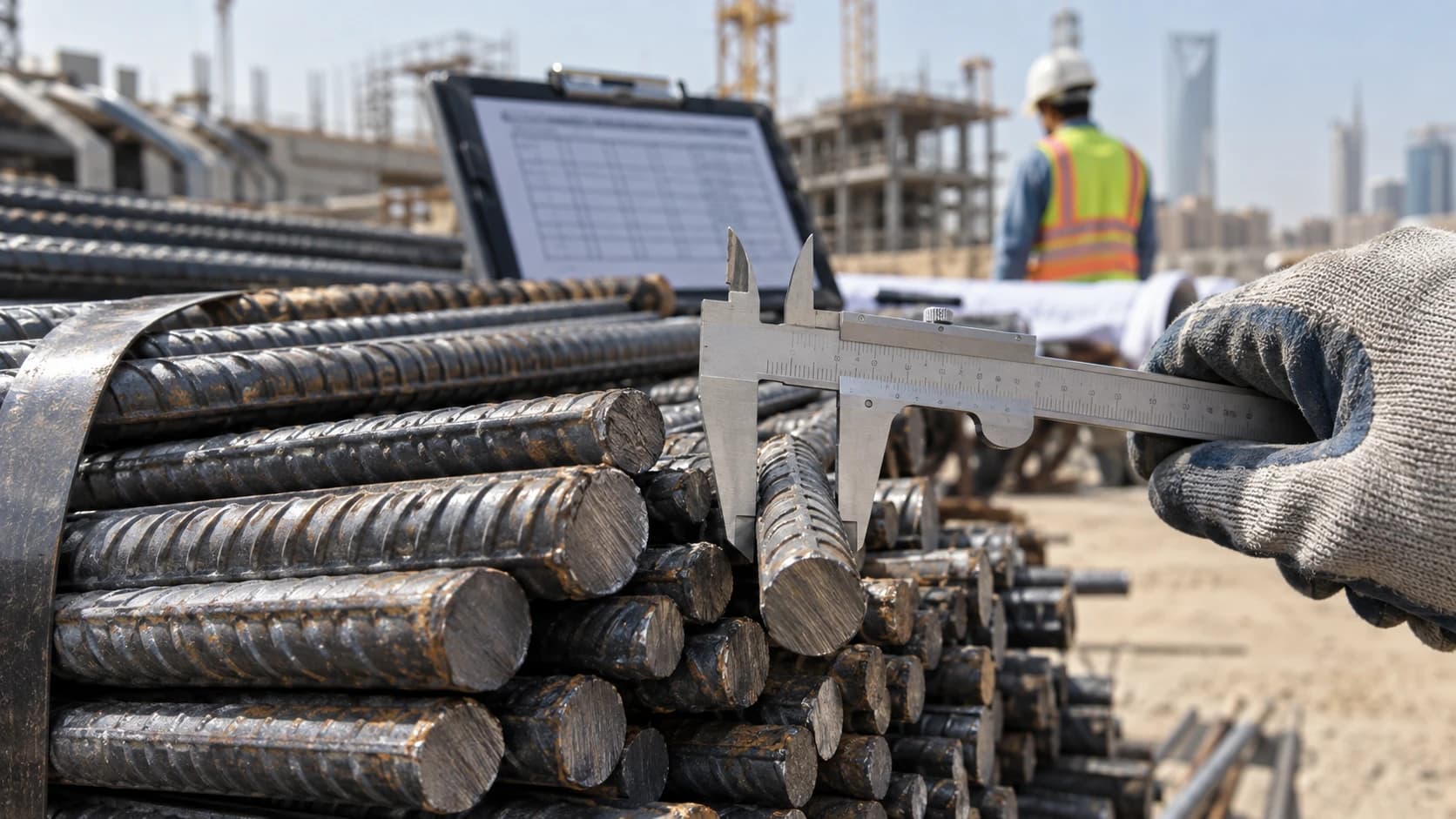
When pricing a project or calculating steel quantities for a pour, engineers need a quick mass-per-metre figure for each bar diameter. This chart collects the standard theoretical weights for diameters common on Saudi projects, how to calculate total weight, and the important difference between the theoretical figure and an actual rebar test result.
Rebar Weight Chart by Diameter
| Diameter (mm) | Area (mm²) | Theoretical Mass (kg/m) | Common Use |
|---|---|---|---|
| 6 | 28.3 | 0.222 | Ties and light secondary reinforcement |
| 8 | 50.3 | 0.395 | Stirrups and light reinforcement |
| 10 | 78.5 | 0.617 | Stirrups and light slabs |
| 12 | 113.1 | 0.888 | Slabs and stairs |
| 14 | 153.9 | 1.208 | Light columns and beams |
| 16 | 201.1 | 1.578 | Residential columns and beams |
| 18 | 254.5 | 1.998 | Medium columns and beams |
| 20 | 314.2 | 2.466 | Main columns and beams |
| 22 | 380.1 | 2.984 | Footings and large beams |
| 25 | 490.9 | 3.853 | Large footings and columns |
| 28 | 615.8 | 4.834 | Heavy structures and bridges |
| 32 | 804.2 | 6.313 | Heavy structures and large bridges |
Mass calculated theoretically assuming 7850 kg/m³ steel density — the standard formula used in deformed-bar weight tables.
How to Calculate Total Weight for a Number of Bars
Total weight = (mass per metre from the table) × (bar length in metres) × (number of bars). Example: 50 bars of 16mm diameter, 12m each:
1.578 kg/m × 12 m × 50 bars = 946.8 kg
This figure is an estimate for pricing and quantity takeoff. The quantity actually received on site should be verified against real weight or the mill-certified bundle weight, not the theoretical calculation alone.
Common Rebar Types Used in Saudi Arabia
The most common reinforcement on Saudi projects is deformed bar to ASTM A615 Grade 60 or the equivalent Saudi standard (SASO) — the base material for reinforced concrete. Higher-strength bar (Grade 80/Grade 420) is used for specific structural elements, and small-diameter plain bar is typically used for stirrups and secondary reinforcement. Grade and diameter selection comes from the structural drawings, not the reference chart alone.
Theoretical vs. Lab-Tested Actual Weight
The chart above gives an ideal theoretical weight. Actual rebar is subject to a manufacturing tolerance allowed within the specification, and the real mass can differ slightly from the theoretical figure without being a defect. Rebar testing in the lab measures the actual mass per metre of a specimen drawn from the batch and compares it against the specification limits, alongside tensile, bend, yield, and elongation tests that no theoretical chart can replace.
💡 Practical Rule
Use the chart for quick estimating and quantity takeoff, and rely on a lab test report to confirm the actual batch before pouring or acceptance.