
What Are You Actually Buying?
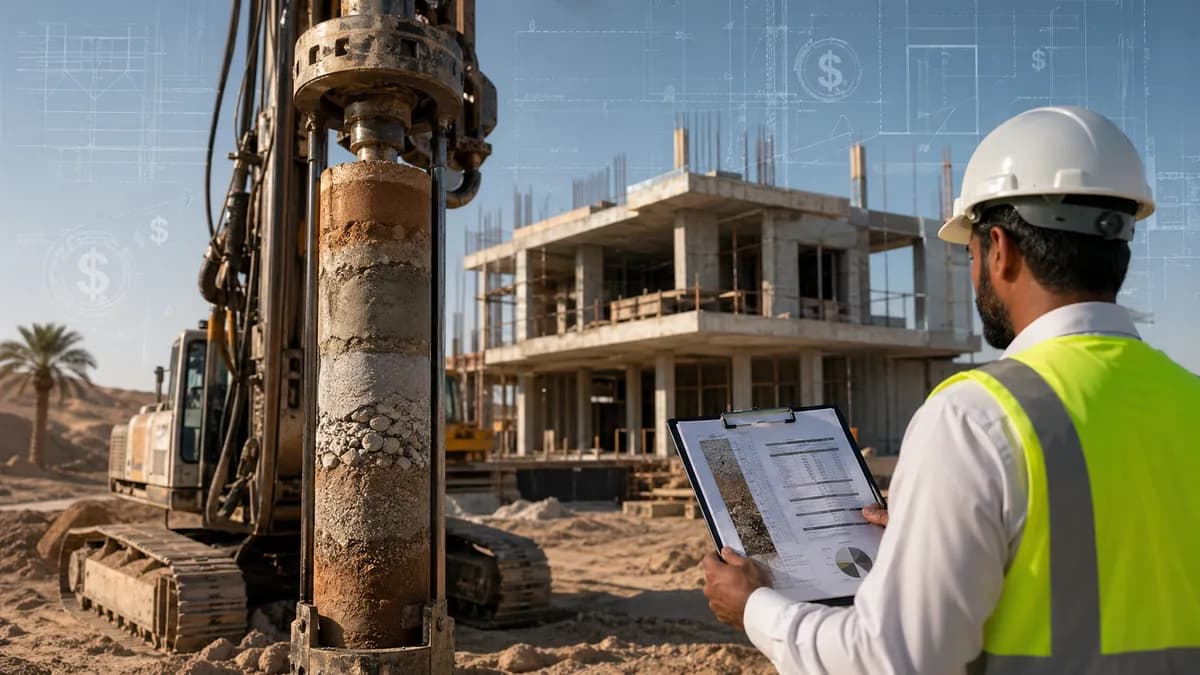
You are not paying for "a paper for the municipality" — you are paying for a full working system that starts with a rig on your land and ends with signed recommendations your foundation designer will rely on:
Field borings
The engineer selects borehole count and depth from site dimensions, structure type and loads, available ground information, and consultant or authority requirements. Plot area alone is not enough to price the drilling scope.
- Proposed borehole count and each location on the plan
- Drilling depth or the criterion used to stop a borehole
- Sampling method and number of SPT measurements
- How rock or groundwater will be handled if encountered
SPT tests
SPT is performed in boreholes under ASTM D1586 when selected in the investigation program. Its results help the engineer interpret resistance and changes with depth. The quotation should state the planned frequency or quantity clearly.
The laboratory program
- Engineering classification (USCS / AASHTO)
- Atterberg limits on clayey layers
- Soil chemistry: sulfates, chlorides, pH
- Organic content where present
The final report
- The geotechnical profile and layer descriptions
- Allowable bearing capacity
- Recommended founding level
- Foundation type, concrete grade, and rebar protection guidance
What Determines Soil Testing and Borehole Cost?
1) Borings: how many, how deep?
Mobilization and drilling are major cost components. Greater depth can change operating time, drilling method, and sampling requirements, so compare total meters and scope rather than borehole count alone.
2) Your site's geography
- Rig access and available working space within the plot
- Travel distance for the field crew and equipment
- Surface obstructions or existing utilities requiring coordination
- Layers encountered during drilling and any justified program changes
3) Tests beyond the basics
- Plate Load — field verification of bearing capacity for major structures
- Collapse Potential — for collapse-prone desert soils
- CPT or Pressuremeter — for in-depth studies
4) Report and review requirements
Ask about report copies, delivery language, drawings, borehole logs, calculations, recommendations, and forms required by the relevant authority. Verify any current licenses or accreditations your project requires; do not rely on a logo in a quotation.
Soil Testing Quote Comparison Table
| Item | What the lab should state | Comparison question |
|---|---|---|
| Drilling and boreholes | Count, depth, locations, and drilling method | Is depth fixed or governed by a stop criterion? |
| Testing | SPT, sampling, and laboratory program | Which tests are included and how are extras priced? |
| Report and delivery | Deliverables, copies, review, and schedule | Are revisions or extra copies included? |
Why the Cheapest Soil Testing Price Is Not Enough
A price difference does not prove that one offer is better or worse; it often means the scopes differ. Check for missing line items before deciding:
- Rig mobilization or travel excluded from the total
- Borehole count or depth left undefined
- Laboratory tests priced later as additions
- Results supplied without a clear recommendation scope
- Delivery schedule or report copies not stated
Compare offers through this lens instead of the price lens:
- A written and clear scope before signing
- Relevant standards and equipment-calibration records
- The person responsible for review and reporting
- Project-required licenses or accreditations that you can verify
Your Next Step
TECHNO Soil Lab is ready to serve you from our Makkah head office and field teams in Jeddah, Madinah, Riyadh, and Qassim. Send us:
- The land's city and district
- Approximate area
- Project type and floor count
After reviewing the information, the team confirms whether the data is sufficient for pricing or whether another drawing or a site inspection is needed before issuing the quotation.
Bottom Line
When researching villa soil testing cost or borehole prices, normalize the scope before comparing totals. Send the same plot and project information to every laboratory, separate mobilization, drilling, tests, and reporting, and verify any regulatory requirements specific to your project before signing.