Laboratory Service

Aggregate Testing Laboratory: Gradation & Density in Qassim

Fine and coarse aggregate testing for gradation, relative density, absorption, bulk density, abrasion, and soundness by intended use and project specification.

Aggregate Testing Laboratory: Gradation & Density

Aggregate Testing in Qassim

Qassim (Al-Qassim) projects use aggregate in concrete, asphalt, fill, and pavement layers, with material arriving from different sources and production lots. Dust or size segregation in open yards can make a surface grab unrepresentative. Testing therefore begins by defining source, lot, size, represented quantity, and intended use rather than relying on stone appearance.

A package selected by end product

Scope may include sieve grading, fines, specific gravity, absorption, and unit weight. Los Angeles abrasion, sulfate soundness, clay lumps, or friable particles may be added when specified. Concrete aggregate, base material, and asphalt aggregate have different questions, and results are compared with the project’s stated ASTM or SASO documents.

Sampling town and rural stockpiles

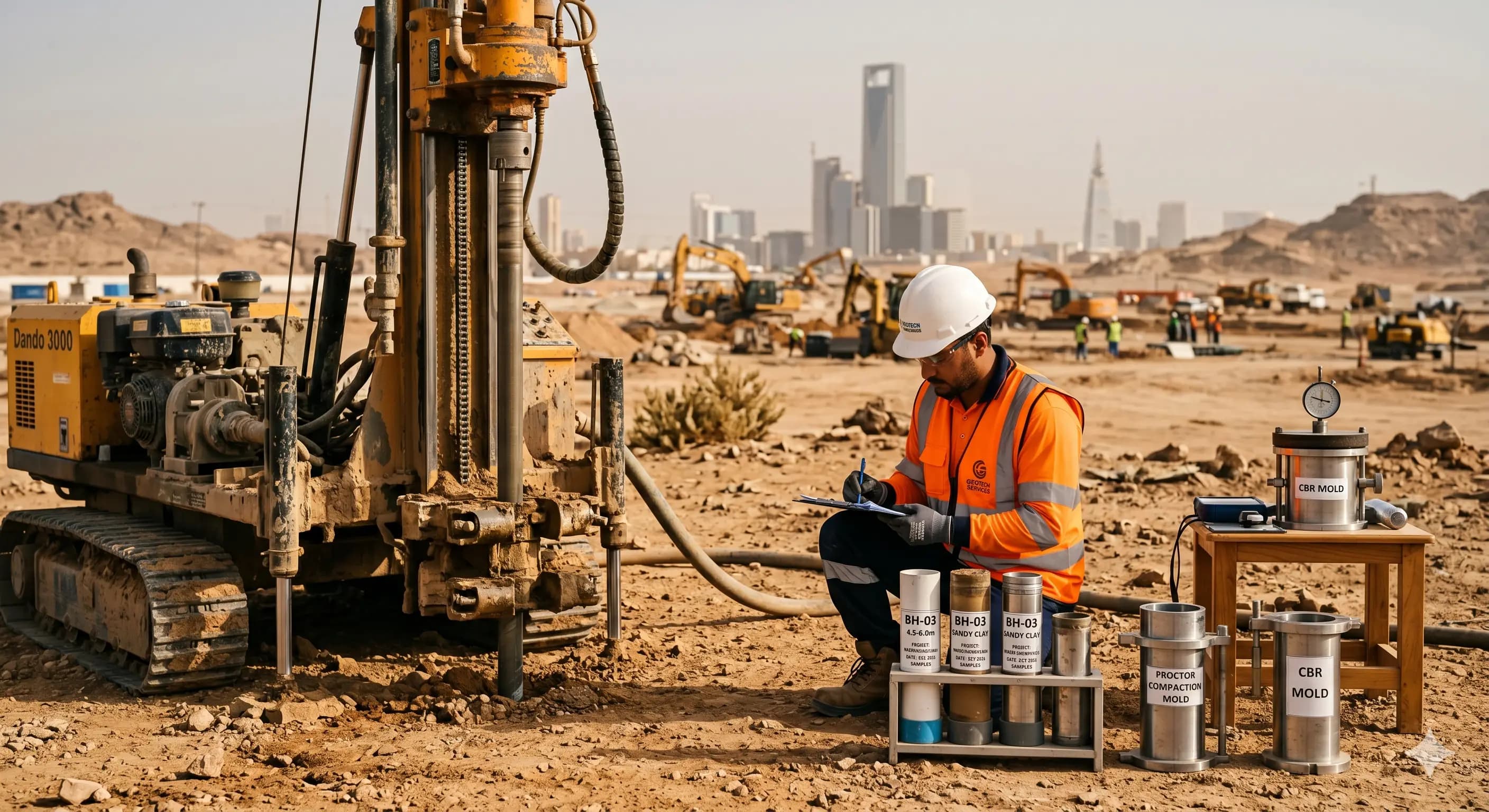
Visits can be arranged in Al Rass, Al Badayea, Al Bukayriyah, Al Quwarah, and Al Fuwarah. On normal days, our Qassim field team works within 5–20 minutes in Al Rass and 70–120 minutes for the far-town group. Gate opening and access to several pile faces also affect collection duration.

Before arrival, separate material by source, size, and delivery date, and mark every pile visibly. State the quantity represented and final application, then provide safe handling access. Material is collected under the plan and reduced while limiting loss of fines or segregation. Source codes remain on containers through reporting so later deliveries cannot be confused with the tested lot.

Areas We Cover in Qassim

Our Qassim field team covers 15 towns and municipalities across five groups around Al Rass. Listed times are typical on normal days and may vary with roads, entry clearance, and site readiness.

Al Rass

≈ 5–20 min
1 districts · Show districts

Al Rass

Towns near Al Rass

≈ 25–45 min
4 districts · Show districts

Al Badayea, Al Khabra, Riyadh Al Khabra, Qasr Bin Aqil

Mid-range towns

≈ 40–70 min
4 districts · Show districts

Al Bukayriyah, Ad Dulaymiyah, An Nabhaniyah, Dukhnah

Far towns

≈ 70–120 min
4 districts · Show districts

Al Quwarah, Al Fuwarah, Az Zahiriyah, Dulay Rashid

Outer region

≈ 90–160 min
2 districts · Show districts

Uqlat As Suqur, Dariyah

Estimated driving times from the lab on normal days; they can be longer during Ramadan and the Hajj season.

In Short

Aggregate testing evaluates a representative fine- or coarse-aggregate sample for its intended concrete, asphalt, or road-layer use. Scope can include gradation, fines, relative density and absorption, bulk density, abrasion, and soundness. Results are compared with the project grading envelope and limits; one package or limit does not fit every use.

Fine and Coarse Aggregate Testing Laboratory

Aggregate covers materials that differ by source, size, and use. Sand is not prepared or interpreted like gravel, and concrete aggregate may have requirements different from asphalt or base-course aggregate. A test request therefore begins with source, nominal size, intended use, and required specification.

Machine precision cannot rescue an unrepresentative sample. Particles can segregate during handling, and quarry faces or supplier stockpiles can change. Sampling and reduction should follow an appropriate plan while identity remains tied to the batch. The report describes the tested sample; supplier or stockpile representation depends on how and how often it was sampled.

Separate fine, coarse, and different-source aggregate samples
Compare particle-size distribution with the project grading envelope
Report relative density, absorption, and bulk density as distinct properties
Link abrasion or soundness results to the correct use and specification limits

Aggregate Testing Scope for Concrete, Asphalt and Roads

Tests follow the project question instead of one list being applied to every sample.

Gradation and Physical Properties

Tests describing size distribution, mass, volume, and water absorption.

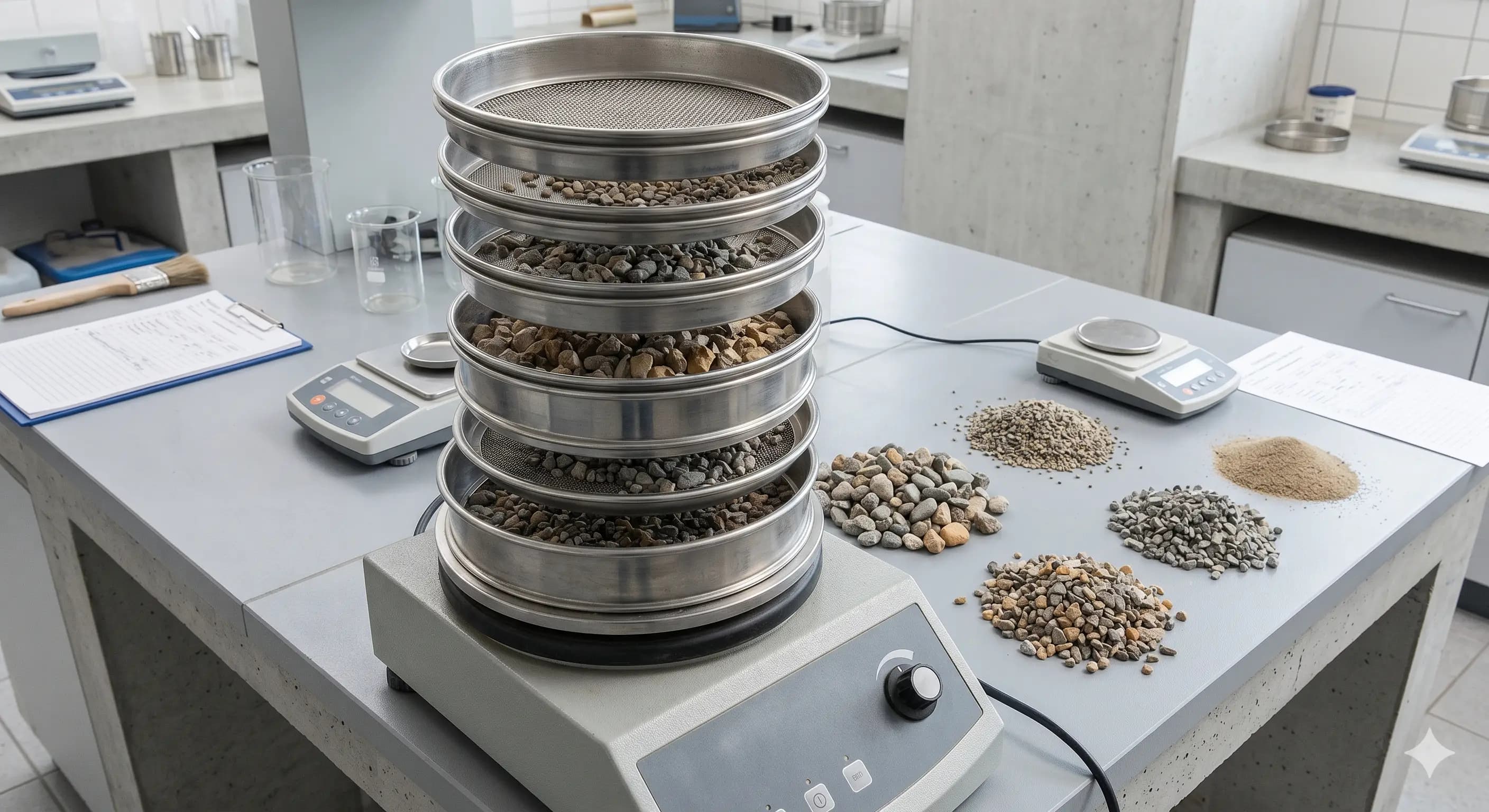
Sieve analysis and aggregate gradation
Material finer than the 75-μm sieve by washing where requested
Relative density and absorption for coarse or fine aggregate
Bulk density and voids where included in scope

Durability, Deleterious Materials and Classification

Tests selected according to use, exposure, and material source.

Los Angeles abrasion for gradings covered by the method
Sodium- or magnesium-sulfate soundness where specified
Clay lumps, friable particles, or specified deleterious materials
Petrographic examination where rock and component characterization is needed

Common Aggregate Testing Standards

The method, edition, and project limits are confirmed before any conformity evaluation.

ASTM C136/C136M

Sieve analysis of fine and coarse aggregates

ASTM C117

Material finer than the 75-μm sieve by washing

ASTM C127 / C128

Relative density and absorption of coarse and fine aggregate

ASTM C29/C29M

Bulk density and voids in aggregate

ASTM C131/C131M

Abrasion and impact of small-size coarse aggregate in the Los Angeles machine

ASTM C88

Aggregate soundness using sodium sulfate or magnesium sulfate

ASTM C142/C142M

Clay lumps and friable particles

ASTM C295/C295M

Petrographic examination of aggregates for concrete

From Aggregate Sample to Gradation Curve and Report

Source identity and sample reduction are part of result quality.

1

1. Define Source and Use

We collect aggregate type, source, batch, nominal size, intended use, specification, and requested tests.

2

2. Sample and Reduce

A representative sample is selected and reduced to test portions while limiting segregation and preserving identity.

3

3. Condition and Test

The sample is conditioned under the method before the specified gradation, density, absorption, or durability tests.

4

4. Report and Compare

The report presents values, curve, method, and supplied use limits, highlighting items needing review.

Included Tests

8 field and laboratory tests available by project scope

Standard aggregate sampling

أخذ عينة من الركام

Unit: sample

Sieve Analysis

التدرج الحبيبي

ASTM C136

Unit: sample

Los Angeles Abrasion

مقاومة التآكل — لوس أنجلوس

ASTM C131

Unit: sample

Solar Reflectance Index (SRI)

مؤشر الانعكاس الشمسي (SRI)

ASTM C1549

Unit: sample

Clay Lumps & Friable Particles

نسبة المواد المفتتة (كتل طينية)

ASTM C142

Unit: sample

Magnesium Sulfate Soundness

مقاومة كبريتات المغنسيوم

ASTM C88

Unit: sample

Petrographic Classification

المكونات المعدنية (Petrographic)

ASTM C295 / C295M

Unit: sample

Specific Gravity & Absorption

الوزن النوعي ودرجة الامتصاص

ASTM C127 / C128

Unit: sample

Equipment used for this service

Why Choose Us

Why TECHNO Soil Lab?

8
Available Tests

Field and laboratory tests selected to match the project scope

15+
Years Experience

Accumulated technical experience in testing & engineering consultancy

5
Cities Served

Head office in Makkah, with equipped field teams in all five cities

The complete Aggregate Testing Laboratory: Gradation & Density guide

Test selection by project type, the pre-contract checklist, what drives the quote and what the report contains — on the main service page.

Read the full guide

Related Reading

Common Questions

FAQ About Aggregate Testing Laboratory: Gradation & Density

On normal days, typical arrival starts at 5–20 minutes within Al Rass, then 25–45 minutes for nearby towns, and reaches 90–160 minutes for the outer region. These estimates vary with roads, entry clearance, and site readiness.

Other Services You May Need

Explore the rest of our accredited engineering tests in one place

Need Aggregate Testing Laboratory: Gradation & Density Services?

Our specialized team is ready to mobilize to your site anywhere in the Kingdom.